

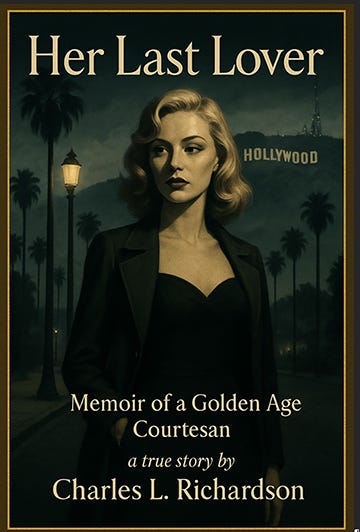
Her Last Lover
Remembering a Golden Age Courtesan

Chapter 13 – 1947 Continued
What the world did not learn until much later was how quickly Howard Hughes was becoming disconnected from reality. Around the time Marla was sealing the deal with Charles Grayson to help Hughes prepare for his scheduled August hearing, Hughes vanished from public view. He leased a motion-picture studio on the outskirts of Los Angeles and retreated there.
For nearly four months, he lived in self-imposed seclusion, sleeping odd hours, watching movies endlessly, and subsisting on candy bars and milk. Outside, reporters speculated about his whereabouts while senators denounced his absence. Inside, the nation’s most celebrated aviator-industrialist drifted through a private twilight world of projection screens and shadows, often sitting naked amid his trash, urinating on the floor and into bottles left lying around. He emerged only when the pressure became impossible to ignore.
When he finally appeared before the Senate committee on August 6, he was gaunt, wearing rumpled, ill-fitting clothes, angry and on edge. Because his publicists had been reminding the public of his early aviation accomplishments, Hughes had become something of a national hero. The public was behind him. The scene in the Senate caucus room took on a circus-like atmosphere.
People turned out to see and cheer for him, filling the room with about 1,200 attendees. When Hughes entered the room fifteen minutes late, according to reports at the time, he uncharacteristically appeared both puzzled and appreciative of the crowd’s support. With a surprised look on his face, he turned, attempted what he considered a smile, and waved to the crowd.
On the second day of questioning, fed up with what he considered a waste of his time, Hughes went on the offensive. When Brewster announced that he intended to delve into “things of a more personal character,” Hughes cut him off, and—as Time Magazine described the scene,
“With no delicacy whatever, Hughes launched into his accusation. “I charge specifically that during a luncheon at the Mayflower Hotel in the week beginning Feb. 10, 1947, in the suite of Senator Brewster, that the Senator told me in so many words that if I would agree to merge Trans World Airline [which Hughes controlled by owning 46% of its stock] with Pan American and would go along with his community airline bill, there would be no further hearings in this matter.”[1]
From there, the hearing devolved into mutual accusations, further indicating that Brewster’s actions were in his own self-interest. The committee attempted to enforce rules that Hughes found unfair. He called them out on this, drawing applause from the public observers in the room. After a few more days of threats, arguments, and difficulty controlling the crowd of visitors, the hearing collapsed and was discontinued and adjourned, and no final report was issued.
While his initial attraction to Marla may have been for unsavory reasons, her subsequent activities on Hughes’ behalf suggest she was a valued “personal assistant” whom he kept separate from his carefully curated collection of sexual partners under contract with RKO. We have no way of knowing what Marla could have testified to, other than confirming what most people already knew or were learning about Hughes. Hughes and his minions must have considered it significant, and the cost of silence is high. Someone had to finance Marla’s new life in Europe, at least for several years. For Hughes, doing so would have been a small price to pay for her proven loyalty.
Leaving the U.S. appears to have been Marla’s final task for Hughes. Afterward, Hughes’s mental deterioration continued, marking his tragic transition from a dashing billionaire tycoon to an isolated, drug-addicted recluse. Driven by chronic pain from a near-fatal 1946 plane crash, worsening obsessive-compulsive disorder, and severe paranoia, he withdrew from public life. He spent his final years in darkened rooms, neglecting his health and hygiene.
Despite his profound personal decline and controversial business practices, Howard Hughes’s ultimate legacy is positive. His vast wealth was ultimately channeled into enduring structural advancements for society. He aggressively bought out Las Vegas casinos, permanently breaking organized crime’s grip and establishing transparent corporate frameworks that enabled the city’s modern economic prosperity.
He also dedicated his empire to founding the Howard Hughes Medical Institute, which he established as a self-sustaining scientific engine that funds hundreds of elite medical researchers today. He prioritized high-risk, groundbreaking biomedical research over safer projects, channeling his wealth to drive global breakthroughs in genetics, neuroscience, and medicine, thereby transforming his chaotic life into a permanent catalyst for human progress.
Chapter 14 – 1948 - 1952
In Europe, on her own now and based in Switzerland, where her income source or sources could remain hidden, Marla didn’t take long to re-emerge. On July 29, 1948, New York columnist Dorothy Dix announces:
“Marla Harrington, of the U.S., who has lived for more than a year in Switzerland, will wed a rich Spanish marquis.”[2]
Evidently, someone changed their mind, as the wedding was either short-lived or never occurred. About 18 months later Walter Winchell puts her in the arms of a heretofore unknown newcomer to America’s gossip and social columns:
“…Prince Ramier (sic) of Monte Carlo and Marla Harrington cementing international relations…”[3]
Monte Carlo,” more properly the Principality of Monaco, has never had a “Prince Ramier.” At that time, he was unknown in the U.S., so it was probably a simple misprint of an unfamiliar name, Ranier.
At the time, Ranier III (Rainier Louis Henri Maxence Bertrand Grimaldi), who was one-quarter Mexican ethnicity, was just 25 years old and had been Prince of Monaco for less than eighteen months. Marla was 27. Prince Ranier did not become widely known in the U.S. until five years later, when he famously visited Philadelphia to meet Grace Kelly’s family and announce their engagement.
Two years later, Marla surfaces again when The New York Daily News gossip columnist Danton Walker picks up the latest thread on September 30, 1952:
“Marla Harrington, who hastened to Europe when Johnny Meyer was making headlines, is making some headlines of her own in Venice in company with Prince Dado Ruspoli, the Peck’s bad boy of Italy.”[4]
Like Howard Hughes, Prince Alessandro “Dado” Ruspoli (9th Prince of Cerveteri, 9th Marquis of Riano, 14th Count of Vignanello, Prince of the Papal States, and Grand Master of the Holy Apostolic Hospice) was a legend in his own time. In December 2024, Rome celebrated the centenary of his birth with events honoring his contributions to Italian culture and to cinema.
Dado’s flamboyant lifestyle and magnetic personality inspired Federico Fellini’s 1960 classic La Dolce Vita. His third wife, Patricia, described him as “an alchemist of life, transforming the everyday into the marvelous.”
With great wealth inherited from his Brazilian mother, Dado was an occasional actor in about a dozen Italian films and had a small role in The Godfather III. He was a popular Roman known for his eccentric lifestyle, charismatic personality, and flamboyant walks along Via Veneto, often with a parrot perched on his shoulder.
In addition to his social prominence, Dado was a patron of the arts who led an extravagant lifestyle in the 1950s and 1960s. His magnetic presence drew a constellation of luminaries from the worlds of art, literature, and cinema. Marla was partying with him in Venice shortly after the death of his first wife, one of three. He died in 2005.
In the summer of 1953, Marla’s reported adventures end as they began…in total mystery.
(Final chapter coming soon…)
[1] Time Magazine, Ausust 18, 1947. Dual Under the Klief Lights.” Probably the most succinct summary of the hearings extant. Full records and related material in the archives at University of Nevada, Las Vegas.
[2] Dix, D. “Broadway and Elsewhere” Buffalo Evening News, July 29, 1948. Accessed December 25, 2023.
[3] Winchell, W., December 19, 1950, The Charlotte (NC) Observer. Accessed November 6, 2023.
[4] Walker, D., September 30, 1952, “Broadway” New York Daily News. Accessed November 5, 2023.