

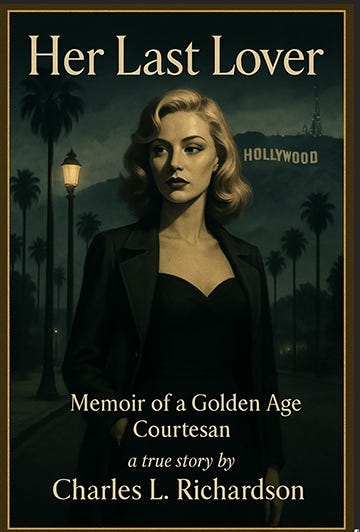
Her Last Lover
Remembering a Golden Age Courtesan

Chapter 4 – 1987
Just as Marla didn’t socialize with the women’s group that often visited Heather’s salon, she also stayed away from various charity balls and similar events that filled the busy Phoenix and Scottsdale social seasons, starting with the arrival of cooler weather in October. Besides her occasional visits with Heather at the Arden salon that fall, we didn’t see her socially until late December.
She called early on Christmas morning, 1987, inviting us to her house for Christmas brunch. With nothing scheduled until the family Christmas dinner that late afternoon, we decided that visiting one of our favorite friends was the perfect way to spend part of an otherwise quiet holiday.
It was a colder-than-usual, windy day—perfect for sitting by her fireplace to finish a second bottle of champagne after a light meal. Marla’s mood seemed sad, and her thoughts appeared to drift.
“You seem down in the dumps this morning, Marla,” I remarked. “Is something bothering you?”
Startled from her reverie, she looked up at us, then down at her lap, slowly twirling her champagne glass, thinking. She sighed and looked up again, eyes glistening with unshed tears.
“I’m sorry,” she said, “I’m not good company today. Christmas is a hard day for me, so I wanted some company... It’s the day my honey died.”
I was stunned. She hadn’t yet said a name; she didn’t need to. She seemed to assume that we already knew. Since her remark last summer that her honey had been a “famous clown,” my suspicion was finally confirmed. I knew that Charlie Chaplin, the Little Tramp, died on Christmas Day, 1977.
Tears sliding down her cheek, Marla lifted her glass.
“Today’s the tenth anniversary of his death,” she said. “I couldn’t let the day pass alone… again.”
With a catch in her voice, she continued, “He was so kind and gentle. I miss him so much.”
She then continued with the next chapter of her story:
By mid-1975, Chaplin’s health and a series of strokes kept him from visiting her at the home he had arranged for her in nearby Lausanne. He had always promised to care for her and assured her that he had planned her future care after he was gone. She trusted him and never doubted his words.
A year passed, then a second one, as Chaplin barely clung to life. About a month before he died, two of his “lawyers” visited her to discuss her plans. She didn’t know if they represented his family or one of his numerous legal entities. Both had British accents. They assured her that while Charlie had indeed planned for her care, she should also understand that there were necessary conditions to protect his family and business interests: She could never reveal the source of her future funds or her relationship with Chaplin. If she agreed to those terms, she would continue living a life of relative luxury.
One of the conditions, they said, was that she could not continue living in Switzerland. They asked where she wanted to live, and arrangements would be made. Marla told them she had spent most of her life in the Los Angeles area and would prefer to return there. This made the lawyers pause; they moved aside and conferred quietly, then told her that privacy issues ruled out Los Angeles because she and Charlie had acquaintances there who might deduce what she had been doing for the past two decades.
She didn’t bother to tell them that they were naive about how things worked in Hollywood and that anyone she might still know there probably already knew of the relationship. She then suggested Phoenix, hoping these “representatives” were unaware of their friendship with the Boyers, since the two men had been close friends. That didn’t raise eyebrows, so she agreed to quietly fade away, return to the U.S., and keep her mouth shut.
The final written agreement was returned a few days later. She signed it, then began planning her departure from Europe, taking only her large wardrobe and modest jewelry she had collected over the years. In January, one of the lawyers contacted her to say that the arrangements in Phoenix were complete, allowing her to proceed with her plan.
With this confession, Marla once again seemed to retreat into her shell. I worried she might regret her admissions, so I held back my curiosity. The dam had been broken, so she probably would clarify everything by continuing her story soon.
Chapter 5 – 1988
Following Marla’s “famous clown” admission the previous year, my candidate for her lover settled on Chaplin. None of the biographies detailing his life and often outrageous behavior mentioned Marla’s name, nor did I expect they would. My original theory was that Marla went to Europe to follow him and continue a previous relationship. With no living family or contemporaries to ask and Switzerland’s legendary secrecy laws, I couldn’t find a way to connect Marla to Charlie.
Chaplin was a notorious serial womanizer, always favoring much younger women. He was plagued throughout his career by scandals over his affairs, including an infamous paternity suit. No one who knew him would have been surprised that he had kept a mistress during his long marriage to Oona O’Neill, who was barely 18 when they married in June 1943. Those who knew Chaplin well would have been surprised if he had not done so, despite his often-repeated protests of love for and fidelity to Oona.
He was one of the wealthiest men of his era, able to support numerous paramours whenever he wished. Marla’s comment that Chaplin was “kind and gentle” offered a striking new insight into the man. Those who knew him well, as well as his biographers, generally depicted him as volatile, dictatorial, and sometimes cruel.
A person very different from the man Marla knew and loved. Or, as Marla’s statement suggests, she might have been La Traviata’s Violetta, leaving her sordid past behind for the love of Charlie, her Alfredo.
Chaplin was an intellectual socialist and supporter of communist causes during the early years of the Soviet Union. J. Edgar Hoover and his FBI, starting in 1922, attempted to find evidence that Chaplin was a ‘card-carrying’ communist. Failing to prove that, Hoover devised another strategy to remove him from the U.S.
Since Chaplin was still a U.K. citizen, his entry rights to the U.S. were revoked when he sailed from New York to London in September 1952 for the London premiere of his new film, Limelight. A Hollywood fixture since 1914, Chaplin was so angry that he vowed never to return to the U.S. again. After spending two years in his native England, he decided to move permanently to Switzerland.
He did, however, return to the U.S. once, in 1972, to accept an honorary Oscar, recognizing “the incalculable effect he has had in making motion pictures the art form of this century.”
In early 1988, Marla’s friend Connie Goulandris moved back to New York after her husband’s death. The telephone became Marla’s main emotional outlet. Our friendship remained normal, but the pressure she had felt before was gone. She now had someone she could talk to freely.
Marla did continue to share remembrances about Charlie when it was appropriate to our discussion and when no one other than Heather and I were present. These gave additional insights into her perception of her long-time lover.
He once remarked on how peaceful it was to visit her because he “had too many kids at home.” He and Oona had eight children at home until Geraldine left on her own in the 1960s. Getting away from home was easy thanks to his numerous business interests, which he said required him to attend meetings in Lausanne. A porte-cochere at her apartment allowed him to slip in and out unnoticed. In reality, because he was one of the richest men in the world, his various business interests always went to him at his estate, a few miles from Lausanne.
Around 1970, honey’s visits dropped from once a week to every two weeks. He was experiencing what he called “incidents,” so he reduced his outings from his house. He still made regular telephone “business calls” to her, complaining that he often needed a wheelchair to get around. In the spring of 1975, he traveled to London to receive his knighthood from Queen Elizabeth. He didn’t call again after his return, when he almost entirely used a wheelchair, and his minor strokes increased in frequency. She admitted that she then became a bit concerned about his promise to always take care of her. But the bills continued to be paid through whatever arrangement he had made for her carefully selected apartment.
Over time, she also made remarks that answered some of my questions about her Hollywood days. The most revealing was that she knew Chaplin in Hollywood only through their many mutual friends; she had not been romantically involved with him until they met again at an event in London, around the time he decided to move to Switzerland in 1954. She was already living there sporadically while “visiting friends” around Europe. She did not explain how she eventually came under his care there.
I concluded that—in her mind—since we now knew her big secret and why she moved to Phoenix, that probably was all we were interested in, so she found no reason to say more. Had Heather or I asked, she might have been willing to tell us more about her earlier life, as we now had a more relaxed relationship. With Connie back in Marla’s life, however, I didn’t want to risk seeming too curious about her. The line between friendship and curiosity was too thin.
Indeed, Connie never visited Marla in Phoenix. We found this odd because Connie could easily afford to visit. Marla also never received an invitation to visit Connie in New York. It seemed strange behavior for one’s “best friend.”
Our friendship, visits, and occasional lunches and dinners continued as before. Nothing changed until the early summer of 1991. Then, it changed dramatically.