

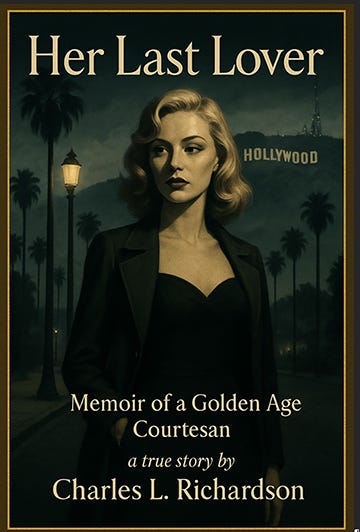
Her Last Lover
Remembering a Golden Age Courtesan

Chapter 15 - 1953
Danton Walker of the New York Daily News is the last gossip columnist to cover Marla, who—somewhat miraculously, given the entertainment industry’s typically short memory—still draws attention six years after fleeing the U.S.
In his “Broadway” column on July 17, 1953, Walker opens a section of his column with this “bolded” announcement:
“Marla Harrington, former Hollywood and New York glamor girl, was quietly wed to the Count de Tornay in Biarritz recently…”
A little girl’s fairy-tale ending… correct? Not quite. There are a few issues with this announcement, but it apparently served its purpose.
There has never been a “real” Count de Tornay. It’s an obvious American misspelling of Tournay or of a similarly named location. There IS a fictional Count of Tournay in Baroness Orczy’s classic novel, The Scarlet Pimpernel.
In the early 1950s, the French/Basque beach resort of Biarritz was enjoying a resurgence of its pre-WWII fame as a playground for the rich and famous. Movie stars, the unseated remnants of European royalty, American and European moguls, and the newly wealthy international jetsetters from around the world flocked there in the summer as part of the international “social season.” The same cohort rotated among Biarritz, the Geneva/Lausanne/Vevey/Montreux area of Switzerland, Paris, the Riviera, and Monaco.
For the past six years, the rumor-and-gossip network has placed Marla directly in that circuit, as she had been ten years earlier in the Hollywood circles. It was a great place for an attractive young woman to make friends and meet potential partners. As always, the edges of the “in group” were circled by an admixture of relatively poverty-stricken nobles and other down-at-heel aristocrats looking for monied partners. They were generally known and tolerated but relegated to the fringes, as they had been for centuries.
I believe Marla was too experienced, wily, and wise to hook up with a con man or fortune hunter from that fringe. Sadly, even though she was not on the fringe herself, I suspect her role was the same. Funding from Hughes couldn’t last forever, and she probably knew of his deteriorating condition.
There is a much more logical explanation, rooted in pure luck and circumstances. Marla’s stars were aligning, taking us back to where it all began: Charlie Chaplin.
When Chaplin was barred from returning to the U.S. in 1952 and swore he would never return, the England he had emigrated from more than fifty years earlier wasn’t the place he wanted to stay, primarily for tax reasons. Charlie decided to move to Switzerland and bought the Manoir de Ban at Corsier-sur-Vevey, moving his large family there in January 1953. From then on, he lived on the shores of Lake Geneva, entertaining friends and visitors from around the world. He had been a fan of Biarritz since his first visit in 1931, but it’s highly unlikely he went there in 1953. He and Oona were not “circuit” travelers anyway…too many kids! He preferred to see his old friend on his turf, and that was fine with them!
We know Marla was acquainted with Chaplin because he introduced her to his good friends, Charles and Pat Boyer. We don’t know how, where, or when Marla and Chaplin reconnected, but it would have been sometime between his move to Vevey in January and the Biarritz summer season in 1953.
From Chaplin’s perspective, though, there was a potential fly in the ointment. Publicly, Chaplin was “happily and committedly” married to Oona O’Neill and had a large family of children with her. In Chaplin’s past, a succession of young women as discarded mistresses would not have been a problem, but having a mistress in his new home area could be. That is, of course, assuming it would be an issue for Oona. By then, she had secured her place in Chaplin’s legacy. But Oona was fiercely protective of Chaplin’s public image and legacy, as well as their large family. If Harrington was Chaplin’s hidden mistress, keeping her in Switzerland and the surrounding area would have required total discretion.
That brings us back to Danton Walker. Walker was the new gossip king in New York, with a deep intelligence network. If whispers began circulating in the summer of 1953 that a glamorous American woman linked to Howard Hughes was living near Chaplin’s estate, it could create a major problem, since Hughes and Chaplin were known to be friends.
Planting a story with Danton Walker, announcing a ghost “quiet wedding” to a count, would effectively put Marla out of the public eye, so long as she stayed away from it. If this was what was done, as is likely in my view, it was a masterstroke. It told the press, “Marla is now married, she has a title, and she lives in Europe, so stop looking for her.” It gave her a legitimate reason to live in peace without drawing a straight line back to Chaplin.
Marla’s account of how Chaplin’s attorneys handled her in Lausanne is a classic “old-school” textbook example of how powerful men have always handled such situations: identify potential difficulties and do what’s necessary to remove them. This is known as estate containment.
Marla’s long-term, unacknowledged relationship was a major liability. If Marla had remained in Switzerland after his death, she could have challenged the estate, spoken to the eager European tabloids, and disrupted the distribution of Chaplin’s vast fortune.
The agreement she signed, which conditioned her immediate departure from Europe and a strict ban on returning to the media glare of Los Angeles, was a classic non-disclosure settlement masquerading as an annuity. Banishing her to a quieter secondary hub like Phoenix was the attorneys’ way of keeping her “invisible.”
I strongly suspect Oona’s hand is visible here. It is almost impossible that she could NOT have known that Charlie was back to a more advanced age, using his old tricks. By then, she would also have known there was nothing she could do about it except take steps to avoid the damage. As Chaplin’s health rapidly declined in 1976 and 1977, his legal team and probably his fiercely protective wife would have been aggressively securing his legacy and estate for her and her eight children.
Having been one of Chaplin’s teenage conquests herself, she knew about Charlie’s many earlier mistresses (some of them also very young), his habitual indiscretions, and his then-recent paternity suit. From her teenage perspective, she no doubt thought she could keep him on a leash. Indeed, to the amazement of his doubting friends and associates, he did seem to settle down and behave himself.
In marrying Chaplin, Oona severed an already strained relationship with her Nobel Prize-winning (in literature) father, Eugene O’Neill. He disowned her because he opposed her marriage to a 36-year-old man with a background as checkered as Chaplin’s. (He eventually did the same to Oona’s two brothers for other reasons.) Nevertheless, Charlie and Oona defied public scrutiny, remained married for 34 years until Chaplin’s death, and had eight children together.
Oona died of pancreatic cancer at the family estate in 1991, three months after Marla’s death. By then, she was also an alcoholic and a recluse. Her will dictated that her large number of diaries and papers be destroyed upon her death. This suggests there was much of the family legacy, or her own activities, that she hoped to hide.
Marla had lived and played among giants in the movie business, politics, and European aristocracy, but for much of that time, she was little more than a girl. Not as a hanger-on or a groupie. Not as a starlet, though she might have succeeded had Howard Hughes not had other plans for her. He turned her into a social accessory, operating at his whim in the murky background of a murky industry, probably manipulated by others, including those she considered friends. Her story makes that unmistakably clear.
One comment she made in her confession on Christmas day, when she revealed her great secret to Heather and me, still resonates in my mind. She said Chaplin was “so kind and gentle.”
Those are far from the words others used to describe Chaplin. Even his admirers, including his biographers, some colleagues, and the many women who had known him intimately, portrayed him as a brilliant yet volatile man, charming but manipulative, at times cruel, a perfectionist to the point of tyranny, aloof, withholding, and cold.
Marla’s view of him was entirely different, and I believed her. To her, he was “a kind and gentle” presence. This suggests she had accessed some corner of his mind and soul that others never glimpsed. It also suggests that her life, and the men with whom she dealt, did not deserve the same admiration, probably dating back to her childhood.
Or, as also happens, she chose to remember only the best parts of him. Either way, her view adds a dimension to the man that has never been seen in print until now
As I finish her story, there is one possibly negative impression I must include. I suspect that her motive for moving to Phoenix wasn’t quite as innocent as she stated, though I do understand why she would not admit to it. Knowing that Pat was dying, I’ve never been able to shake the thought that, if only in the back of her mind, she came hoping to be available to replace Pat in Boyer’s life. But I also know I’m a cynic… but one with a forgiving and romantic twist!
As for Marla, I remember her as a kind and gentle presence, too. I cannot reconcile the woman portrayed in her early years with the one I knew, but I did recognize the social skills she brought to bear when performing sensitive tasks for others. I hope the security and calm of her time with Charlie, reading poetry, listening to him play his violin, and simply spending quiet time together provided her with some of the life she had hoped to find.
End
Afterword
(for those interested in research and minor details)
Marla’s story, as I present it above, is necessarily speculative. I offer theories and conclusions that all available evidence suggests are close to the objective truth. That’s the best a biographer can do with the available sources and diligent research.
Marla’s story is a literary mongrel: part biography, part memoir, and part informed speculation. When planning this project and telling friends the basic storyline, they always asked whether I believed her or if it was all a self-aggrandizing tale.
I had considered and mostly discarded that possibility. As a veteran of the intelligence collection business, I’ve dealt with more than my share of liars looking to “sell” fabricated secrets. With Marla, you also “had to be there” to detect…to feel…the underlying emotion and the difficulty of extracting relevant but unpracticed information from your mind.
Even so, I reserved final judgment until those gossip columns from the 1940s and 50s appeared on my computer screen. She was shown to be part of the circle of Hollywood Golden Age figures targeted by the gossip press, much better known than her meager mentions suggest. That’s because the columnist would expect their readers to know who they were talking about. Otherwise, why bother mentioning them or the gossip item?
Finally, as with much history, including social history such as this, there may be more information available that I have not found. Indeed, I expect there is. I consulted with library archivists at all the places where relevant personal papers are held (e.g., the New York City Library for Walter Winchell, USC, and UCLA for other columnists). In those cases, the files—most of which have not been digitized but are reasonably well indexed—assured me that the materials I needed were not in their archives.
I then spent days at the Academy of Motion Pictures and Arts Margaret Herrick Library, reviewing files that had not been digitized and scanning those that had, and at the archives of the California State University, Northridge, where the Hollywood Studio Club records are preserved as part of the Los Angeles YWCA archives. Additional days were spent reviewing the massive, meticulously indexed digitized files of Hughes’ core corporate records at the University of Nevada, Las Vegas. Other than a copy of the same LA Times 1941 article I had found online, which proved she had been a resident member of the Hollywood Studio Club early in 1941.
To keep things as simple as possible, I did not mention in my story a very important person who was clearly involved in the background of everything Marla did for Hughes. This was Noah Dietrich, arguably the second most important man in Howard Hughes’s empire for nearly three decades. He joined Hughes’s organization in 1923 and served as Hughes’s business mentor, remaining at Hughes’s side until 1957, when he was abruptly fired without explanation.
Dietrich managed finances, negotiated major business deals, oversaw Hughes’s film and aviation ventures, handled personnel matters, protected Hughes from creditors, lawsuits, and political threats, and served as Hughes’s intermediary with government officials, lawyers, and bankers. Many historians regard Dietrich as the practical administrator behind Hughes’s success in the 1920s, 1930s, and 1940s.
Dietrich is especially relevant because he was deeply involved in managing the non-business side of Hughes’s life. He oversaw expenditures for actresses, companions, residences, security arrangements, and confidential projects. While reviewing the UNLV archive files, I scanned them but failed to focus on the thousands of notes, letters, memos, and miscellanea that litter the Hughes files.
Should anyone be interested in delving deeper into Marla’s (or any other of his “influencers”) role with the Hughes organizations, Dietrich’s notes are the place to begin.
CLR