

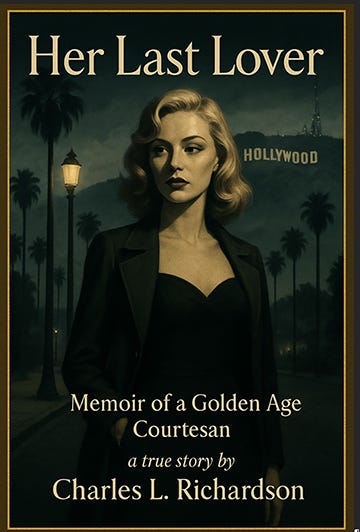
Her Last Lover
Remembering a Golden Age Courtesan

Chapter 12: 1947
Marla likely considered 1947 the most disruptive year of her life. Whether out of fear, loyalty, financial inducements, or a combination of these, we have no way of knowing. It was the year she appeared, fleetingly, in press new releases, as well as gossip columns.
More importantly, it was also the year she fled the USA, as chronicled in a series of gossip columns and press service items that appeared in the second half of the year.
Walter Winchell’s column for the second week of April 1947 announced
”…Chas. Grayson, just un-married, will try it again with Marla Harrington...”1
Since Grayson lived and worked in Los Angeles and Marla was living in New York at the time, she likely went specifically to meet with him. Charles Grayson was a respected Warner Brothers screenwriter and pulp fiction author, best known for his skill at rewriting “problem” scripts. He kept a low profile during his Hollywood career from the 1930s to the 1950s.
A retrospective analysis of gossip column mentions of Marla over the five years since her initial “dynamite” link with Hughes in 1942 strongly suggests that all of those “sightings,” except those when she was in New York, were with people who were of interest to Howard Hughes, for whatever purpose he had in mind at the time. That’s a pattern only apparent in retrospect, so it would not have been recognized by the reporters at the time.
As we know, when Hughes needed something done, he wouldn’t do it himself, whether in business or in his personal life. He would turn to one of his minions to handle the work. Marla, it appears, was one of his “heavy hitters,” reserved for delicate influence and recruitment tasks.
In 1941, Congress formed a committee to investigate fraud, waste, and abuse in government contracts for war materiel. To boost production, the U.S. War Department prioritized speed over efficiency and viewed the Committee, led by Sen. Harry Truman, as a hindrance to the war effort. High-ranking officials, including President Roosevelt, sought to limit oversight and accelerate procurement, recognizing that waste and inefficiency were unavoidable when wartime speed was paramount. Thereafter, the Truman Committee continued, albeit feebly, until after the war ended.
By the beginning of 1947, the Congressional Subcommittee was being led by its new chairman, Maine’s Owen Brewster, toward a thorough investigation of Hughes’ notoriously incomplete wartime contracts. Hughes learned of this and was alarmed. He had always assumed he was immune to outside review (which, to some extent, he was). He decided to preempt the investigation rather than wait to be subpoenaed.
He asked to meet informally and secretly with the committee’s chairman, Senator Owen Brewster, and the committee to discuss the contracts. The two secret meetings on February 10 and 11 did not go as Hughes had planned. Instead, Brewster pressured Hughes to sell or merge his airline, TWA, with Pan American World Airways. If he agreed, they would back off their investigation.
PanAm was Hughes’s sole competitor in international passenger air service, and Brewster was known as a friend of Juan Trippe, PanAm’s founder and CEO. Brewster, no doubt egged on by Trippe, argued that the U.S. should have a single, government-controlled national airline, as many other countries did and still do. Brewster didn’t realize he had picked the wrong man to intimidate. Hughes left the meeting, making it clear he would fight back.
Hughes had an aversion to being seen in public, let alone speaking there. John W. (Johnny) Meyers was Hughes’ respectable yet flamboyant public relations chief and a company vice president, but not a seasoned writer capable of handling the statements and letters Hughes would need before and during hearings before the Senate committee. He needed a skilled amanuensis for the task.
At about that same time, was it a coincidence that the Grayson and Marla contacts occurred, just a few months before Hughes was set to appear before Brewster’s committee? Not likely. After the hearings, rumors circulated that Grayson had provided this assistance to Hughes, but these rumors were never substantiated, even though Grayson’s primary work thereafter “just happened” to be for Hughes’ RKO Studio.
Just days before the Senate Committee opened its hearings in the summer of 1947, a confidential memorandum mysteriously surfaced from the now-deceased Roosevelt’s papers. It shed new light on the origins of the government’s support for Hughes and on why he felt confident he was essentially immune to questioning. Roosevelt had personally and secretly directed the Reconstruction Finance Corporation to underwrite Hughes’s aviation ventures during the war.
Why Roosevelt may have taken this action remains a mystery…or does it? The timing generally aligns with the period following Marla’s “dating” of Roosevelt’s old friend and confidant, Stanton Griffis.
In the weeks before Hughes was set to testify in early August, the Truman Committee was gathering evidence from other Hughes executives to build its case before Hughes himself took the stand. The man at the witness table was Johnny Meyer, who, for years, had maintained detailed notes and receipts relating to his public affairs and lobbying for the Hughes organizations.
Meyer’s testimony, quickly picked up by the press, revealed lavish spending by Hughes’s companies, not only in aircraft hangars but also in nightclubs from Hollywood to New York. A photostatic trail of expenses, meticulously kept by Johnny, detailed a series of extravagant parties for Washington officials in New York and Hollywood during the latter years of the war. Chief among those entertained was Julius Krug, first as vice chairman of the War Production Board (WPB) and later as Secretary of the Interior under Truman.
According to Meyer’s records, Krug and other government and military officials, along with film stars, party girls, and socialites, were entertained at the nation’s finest venues, with Hughes footing the bill through his companies: Hughes Aircraft, Hughes Productions, or TWA. The documents included itemized costs that seem modest today: $435 ($8,200 in 2026) for a single night’s festivities at Mocambo in February 1944; $406 ($7,600) for two nights at the Trocadero; and a $250 ($4,700) party in New York featuring four young women described only as “entertainment.”
It’s Meyer’s documents that bring Marla to the press, rather than gossip columns. Stories from a wide range of reporters and news outlets covering the hearings mention the elaborate parties and, by implication, suggest what Marla likely did during some of her time in New York: organizing parties to entertain the War Production Board, including military officers assigned to the board.
The New York Daily News reports that on January 22, 1944, a party to entertain an Army officer was held at El Morocco and Copacabana, and that M. Harrington was paid $100 ($1,800) for arranging the entertainment. When asked by one of the inquisitors who Miss Harrington was, Johnny Meyer responded,
“Marla Harrington is a Hollywood actress. The $100 was a present.”
Meyer went on to explain that
“During the war, officers did not like to go out and eat and eat
alone, especially if they had been overseas about a year.”2
Another article from the International News Service (INS) reported on July 25, 1947, that, according to Meyer’s testimony and documents, a floating party for three WPB officials and a visiting Soviet Purchasing commissioner, including Secretary of the Interior Julius Krug and the WPB Chairman, was held over two days at Club 21 (lunch), El Barracho (dinner), and El Morocco (dinner the next day). The “girl partners” were Marla Harrington (Chatham Hotel), Elsa Mori (Delmonico Hotel), Marie Windsor (3 E. 75th St.), Jean Duval (Barbizon Hotel), and Janet Thomas (of Beverly Hills), who was flown in from California to be with Johnny Meyer, all at Hughes Aircraft’s expense.
When questioned by the committee’s leading members—Senators Owen Brewster, Homer Ferguson, and Carl Hatch—Krug reportedly broke down, admitting “the optics looked bad” and pleading his case with evident discomfort. All of it—the gifts, the parties, the coast-to-coast flights—portrayed Hughes not only as a wartime excessor but also as a power broker whose influence extended beyond airframes into the corridors of government and the culture of celebrity.
The committee decided it needed to hear from the girls themselves to nail down their case against Hughes. Marla and the other four women were subpoenaed. Initially, a few of the girls were excited about the prospect of free publicity until they learned they would be paid only $3 a day for expenses. They all fled town to avoid being served. A few were located, brought to Washington, and required to testify under oath. They had little to offer and nothing of value regarding Hughes or his companies.
Marla, on the other hand, had boarded a TWA flight for a multi-stop, twenty-plus-hour journey to Switzerland.3
(New chapters coming soon…)
New York Daily News, July 2, 1947. Accessed November 6, 2023
All information about Hughes’ testimony and related matters described are from Hughes corporate files at the University of Nevada, Las Vegas archives and Congressional records.
Newspapers.com, The Durham (NC) Sun, April 12, 1947. Accessed November 6, 2023.